
When Your Firm Starts to Define You More Than You Define It

The Roadmap You Wish You Had 5 Years Ago
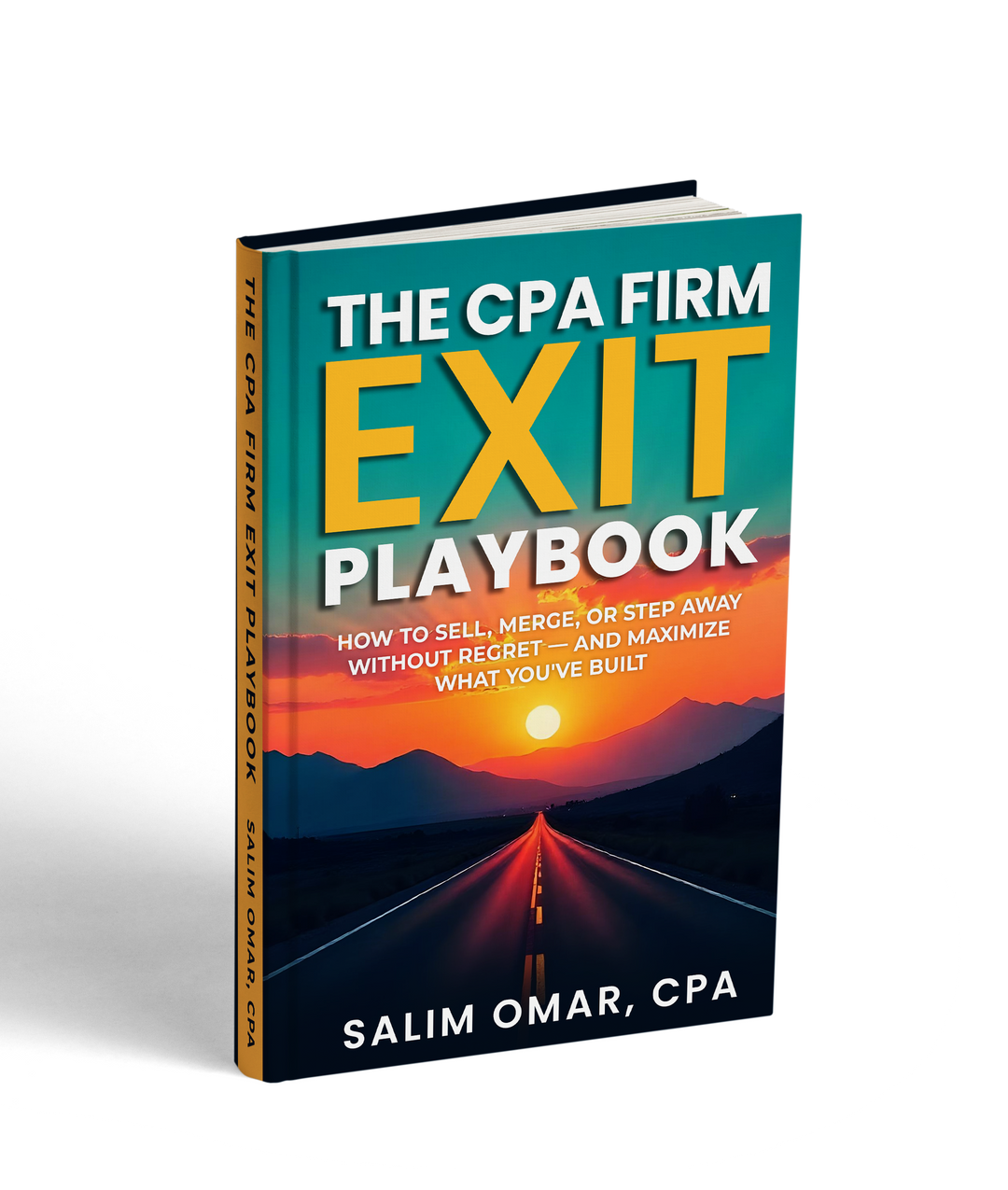
The CPA Firm Exit Playbook gives you proven strategies to maximize value, avoid common pitfalls, and transition on your own terms.
Most CPA firm owners don’t set out to build a firm that traps them.
They set out to build a good firm.
A respected firm.
A firm that serves clients well and supports their family.
A firm they’re proud of.
And for many years, that’s exactly what they do.
But over time, something subtle happens.
The firm becomes more than a business.
It becomes identity.
It becomes routine.
It becomes responsibility.
It becomes obligation.
And eventually, for many owners, it becomes something they orbit around — instead of something they actively shape.
How It Happens Quietly
This shift rarely feels dramatic.
There’s no breaking point.
No crisis.
No collapse.
It happens through repetition.
Clients call you first — so you answer.
Your team looks to you — so you decide.
Problems escalate to you — so you solve them.
Growth depends on you — so you carry it.
Over time, being “needed” feels normal.
Being central feels responsible.
Being essential feels earned.
And slowly, your role stops being intentional and becomes assumed.
Not because anyone planned it —
but because the system formed around you.
The Identity Trap
At some point, the firm stops being just something you run.
It becomes who you are.
Your schedule revolves around it.
Your stress levels are shaped by it.
Your sense of importance is tied to it.
Your self-worth quietly connects to it.
You’re not just the owner.
You’re the fixer.
The closer.
The safety net.
The final decision.
The constant.
And stepping away doesn’t just feel operationally difficult —
it feels personally disorienting.
Because if the firm doesn’t need you as much…
what does that mean about you?
Why This Is So Hard to See From the Inside
From the inside, this doesn’t look unhealthy.
It looks like leadership.
Responsibility.
Commitment.
Dedication.
Care.
And in many ways, it is.
But there’s a difference between leadership and centralization.
Between stewardship and dependency.
Between being valuable and being irreplaceable.
Firms that depend on their owners often feel strong on the surface —
but fragile underneath.
Because everything important flows through one person.
The Cost Most Owners Don’t Measure
This dynamic doesn’t just affect lifestyle.
It affects:
- firm scalability
- team confidence
- leadership depth
- operational resilience
- buyer confidence
- transition readiness
- and long-term value
Owner dependency isn’t just a workload issue.
It’s a structural issue.
It limits optionality.
It reduces leverage.
It narrows future paths.
And the longer it exists, the harder it becomes to unwind.
The Question That Changes Everything
At some point, every firm owner faces a quiet internal question:
“Is my firm built around my leadership — or my presence?”
There’s a difference.
Leadership builds systems.
Presence becomes the system.
Leadership creates resilience.
Presence creates reliance.
Leadership scales.
Presence concentrates.
Redefining the Relationship
Healthy firms don’t remove the owner —
they change the owner’s role.
The owner becomes:
- less central to operations
- less essential to decisions
- less involved in fire management
- more focused on direction, standards, and vision
The firm still benefits from their wisdom —
but no longer depends on their availability.
That’s not disengagement.
That’s maturity.
A Different Kind of Success
True success isn’t building a firm that needs you every day.
It’s building a firm that works because of what you built —
not because of your constant presence.
Where your value comes from:
- structure, not strain
- leadership, not load
- clarity, not chaos
- design, not dependency
A Closing Reflection
If your firm were stripped of your daily involvement tomorrow, what would remain?
Not emotionally — structurally.
Not in theory — operationally.
Not in intention — in reality.
That question isn’t meant to create fear.
It’s meant to create clarity.
Because when you start defining your firm again —
instead of letting it define you —
everything changes.
Your role becomes lighter.
Your leverage increases.
Your options expand.
Your future becomes flexible again.
And the firm becomes what it was always meant to be:
A platform you lead —
not a system that leads you.

About Salim Omar, CPA
Salim Omar is the founder of Straight Talk CPAs and creator of the CPA Exit Accelerator™. With nearly 30 years of experience building, reinventing, and guiding firms, Salim helps retirement-minded CPA firm owners create a smooth, profitable, and purposeful transition — without stress or regret.